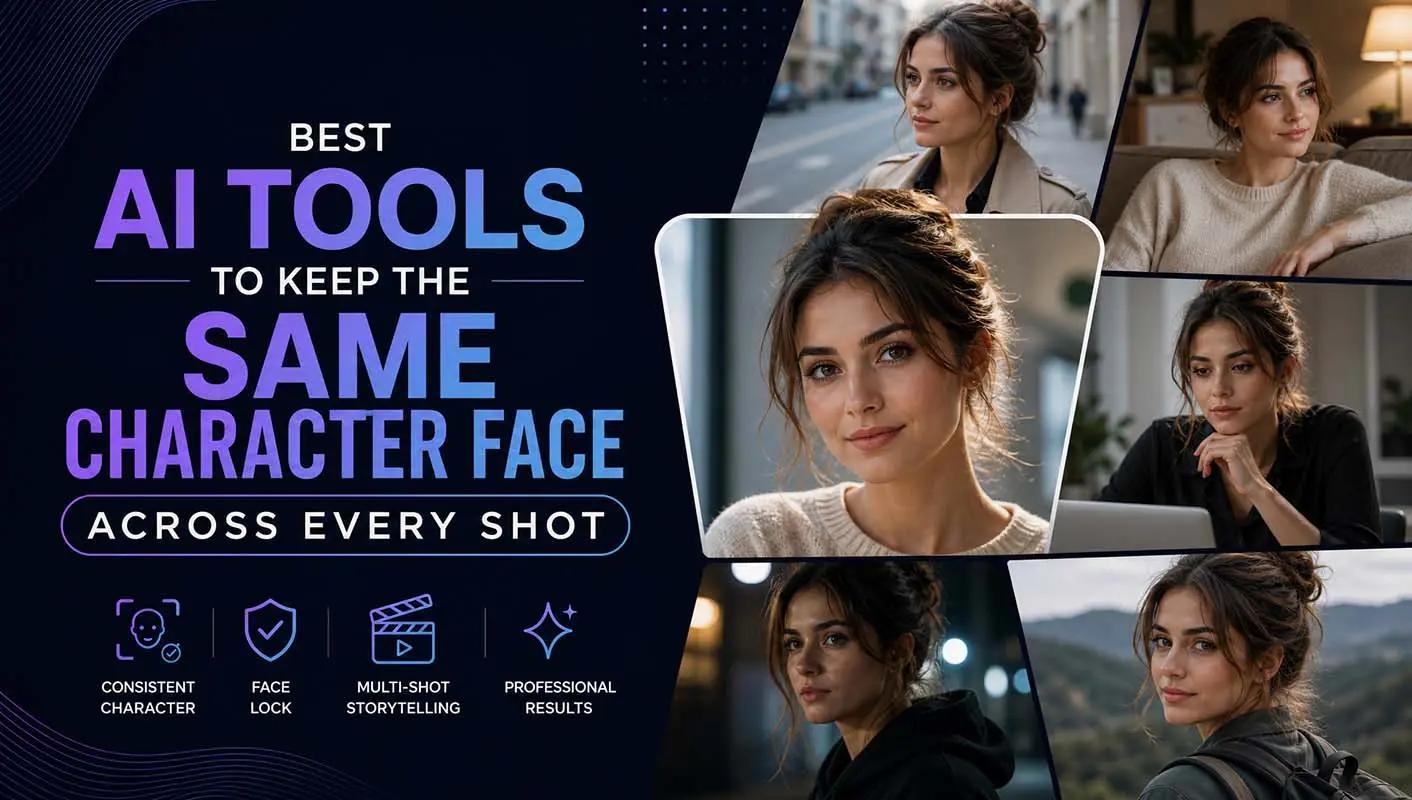
Of everything that can drift across an AI-generated sequence, a face is what a viewer notices fastest. Human perception is unusually tuned to faces specifically, which means the eyes sitting a fraction wider, a jawline softening, a nose shape shifting, registers almost instantly even when everything else about a character, outfit, pose, setting, stays perfectly consistent. This list focuses specifically on the facial-locking mechanisms behind ten tools, not general character consistency broadly, since face identity is the single hardest and most noticeable piece of the problem.
Comparison table
| Tool | Best For | Facial locking mechanism | Starting price |
| invideo agent | A face held identical across every shot, session, and episode of a project | 4K, multi-angle facial reference sheets held in a persistent context engine | $17/month; team and enterprise options available |
| Ideogram Character | Locking a face from one photo with no training required | Reference-image conditioning tying every generation back to a source photo | Free (unlimited generations) |
| Leonardo AI | Locking facial proportions during concept art development | Character Reference tool paired with the Phoenix model | Free tier; $12/month |
| Hedra Character-3 | A talking face with synchronized expression across scenes | Omnimodal processing of image, text, and audio in one pass | $15/month |
| HeyGen | The same avatar face delivering many different scripts | A face generated once from text, image, or video, then reused | Free tier; $29/month |
| ToonyStory | One illustrated face held consistent across 20+ pages | Photo-based facial feature extraction enforced as a generation constraint | Subscription-based |
| DomoAI | A face staying recognizable through head turns and movement | Reference-guided Image-to-Video and Frames-to-Video generation | ~$6.99/month |
| OpenArt AI | A specific face trained for reuse across unlimited future shots | Custom LoRA training on uploaded facial reference images | ~$7/month |
| Vidu Q3 | A face staying stable while interacting with objects or environments | Multi-Entity Consistency across people, objects, and environments | ~$10/month |
| Synthesia | A consistent presenter face across enterprise-scale video | 230+ pre-built avatar faces, individually licensed and locked | $29/month |
1. invideo agent
A face is the part of a character an AI model has the least room to get slightly wrong before a viewer notices. invideo agent locks a character's facial identity through a 4K, multi-angle reference sheet, front, three-quarter, profile, back, plus a dedicated face close-up, held in a persistent context engine that carries that exact face forward into every future shot referencing it, regardless of which of the platform's 200+ integrated models, including Veo 3.1, Sora 2, Kling 3.0, Seedance 2.5 , Runway, PixVerse, Hailuo, WAN, Recraft, GPT Image 2.0, and Nano Banana, actually renders that shot.
Best for: a face that needs to stay genuinely identical across every scene, session, and even multiple episodes of a series.
Where it falls short: the multi-angle reference-sheet workflow is a real production step, asking for more upfront setup than a single-photo locking tool.
Pricing: plans start at $17/month, with team and enterprise options also available.
2. Ideogram Character
Ideogram Character locks a face from a single reference photo with no model training or LoRA required, tying every subsequent generation back to that source image while pose, lighting, and background vary freely around it.
Best for: locking a specific face from one photo without any training step.
Where it falls short: it's an image tool, so its facial locking doesn't extend to video generation on its own.
Pricing: free, with unlimited generations.
3. Leonardo AI
Leonardo's Character Reference tool, paired with its Phoenix model, locks a protagonist's face shape, proportions, and features across every still image in a project, which has made it a standard choice for concept art before a face needs to hold up in motion.
Best for: locking a face's exact proportions during concept art development.
Where it falls short: it's a stills tool rather than a video generator, and the reference feature can lose specific facial traits across a long session.
Pricing: free tier with 150 daily tokens; paid plans from $12/month.
4. Hedra Character-3
Hedra's Character-3 model processes image, text, and audio together in one pass rather than as separate steps, which is the specific architectural choice behind its lip-sync and micro-expression quality for a face that needs to stay recognizable while it's actively talking across scenes.
Best for: a talking face where lip-sync and micro-expression need to feel genuinely synchronized across every scene.
Where it falls short: language support trails avatar-focused competitors, and full-body motion is noticeably stiffer than full-body-focused alternatives.
Pricing: Basic plan from $15/month.
5. HeyGen
HeyGen generates a face once, from text, an image, or a short video, then reuses that exact face across any number of scripts and scenes, applying lip-synced dialogue in many languages without regenerating the face's appearance each time.
Best for: the same avatar face delivering many different scripts consistently.
Where it falls short: it's built around presenter-style delivery rather than the fuller range of narrative facial consistency a story-driven project might need.
Pricing: free tier available; Creator plan from $29/month.
6. ToonyStory
ToonyStory led an independent 140-image benchmark specifically for multi-page narrative facial consistency, extracting a real reference photo's facial features and proportions and enforcing them as constraints across an entire illustrated book or comic.
Best for: one illustrated character's face staying recognizable across 20 or more storybook or comic pages.
Where it falls short: it's optimized for storybook illustration styles rather than photorealism.
Pricing: subscription-based.
7. DomoAI
DomoAI uses an uploaded reference image or character sheet to guide every subsequent Image-to-Video or Frames-to-Video generation, keeping a face recognizable through simple movements like head turns or walking loops.
Best for: a stylized or anime-style face staying recognizable through motion.
Where it falls short: complex motion can still soften facial features, especially during fast or exaggerated movement.
Pricing: plans from roughly $6.99/month.
8. OpenArt AI
OpenArt's custom LoRA training lets a creator upload facial reference images once, train a personalized model of that specific face, and generate it across unlimited future stills and short videos without rebuilding the reference each time.
Best for: a specific face that needs to appear across a large volume of future shots or projects.
Where it falls short: it's a heavier upfront training step than a simple reference upload, and consistency varies across the underlying models it aggregates.
Pricing: plans start around $7/month.
9. Vidu Q3
Vidu's Multi-Entity Consistency keeps a face stable even while a character is actively interacting with a specific object or environment in the same generated video, which matters for shots where a locked face alone doesn't guarantee the rest of the interaction holds together.
Best for: a face staying stable while its character interacts with objects or environments in the same shot.
Where it falls short: for photorealistic human faces from real photos, it trails more specialized live-action models.
Pricing: subscription plans from roughly $10/month for 800 credits.
10. Synthesia
Synthesia's 230+ pre-built avatar faces are each individually licensed and locked, giving an enterprise project a large library of ready-to-use, consistent presenter faces without building a custom reference for each one.
Best for: a large enterprise project needing a consistent presenter face without custom facial training.
Where it falls short: custom faces cost $1,000/year each, and the library's faces read as polished presenters rather than expressive narrative actors.
Pricing: Starter plan from $29/month.
Which one should you use
- A face held identical across every shot, session, and episode → invideo agent
- Locking a face from one photo, no training required → Ideogram Character
- Locking facial proportions during concept art → Leonardo AI
- A talking face with synchronized expression → Hedra Character-3
- The same avatar face across many scripts → HeyGen
- One illustrated face across many storybook pages → ToonyStory
- A stylized face staying recognizable through motion → DomoAI
- A specific face trained for reuse at scale → OpenArt AI
- A face staying stable during object or environment interaction → Vidu Q3
- A large library of consistent presenter faces → Synthesia
Frequently asked questions
Why does a face drift faster than the rest of a character's appearance? Human perception is unusually sensitive to faces specifically, so a small deviation in eye spacing, jaw shape, or proportion registers almost instantly, even when the rest of a character's outfit and pose stay perfectly consistent. That sensitivity is exactly why facial locking gets treated as its own, harder problem rather than a subset of general character consistency.
How many reference images does a face actually need to stay locked? At minimum, a front angle, a three-quarter angle, a profile, and a dedicated close-up. A single reference photo can work for still-image tools like Ideogram Character, but video generation across multiple angles benefits from a fuller multi-angle reference sheet, the kind invideo agent's context engine is built around.
Can a face stay consistent while talking, not just standing still? Yes, specifically what tools like Hedra Character-3 and HeyGen are built for, locking a face's identity while also generating synchronized lip movement and expression, which is a harder combined problem than locking a static face alone.
Is there a way to lock a face without any training step at all? Yes. Ideogram Character ties every generation back to a single reference photo with no model training or LoRA required, which is faster to set up than a custom-trained approach, though it's built for still images rather than video.
Is facial consistency free to test on any of these platforms? Several offer genuinely usable free options, including Ideogram Character (unlimited free generations), Leonardo AI, and HeyGen, though the deepest training-based locking methods and full video generation typically require a paid plan.